
I. OBJECTIVE
Bhumi, a non-profit organization registered as a Society (“Bhumi”) is committed to creating a safe work environment devoid of any form of sexual harassment which can be considered distressing, coercive or disruptive for its employees. Bhumi also believes in treating its employees with respect and dignity, promotes a sense of personal responsibility and is committed to preventing and addressing conduct that could be
tantamount to sexual harassment.
This Policy on Prevention of Sexual Harassment at Workplace (“Policy”) intends to provide protection against sexual harassment in work settings and the prevention andredressal of complaints of sexual harassment. The complaint and redressal procedures have also been provided in this Policy. All allegations of sexual harassment shall be taken seriously by Bhumi and shall be governed by this Policy.
II. IMPORTANT DEFINITIONS
Some of the terms which have been used commonly in this Policy are defined below.
Sexual Harassment: This is any unwanted, unwelcome or uninvited behaviour of a sexual nature (whether direct or by implication) which makes a person feel humiliated, threatened, intimidated or offended.
Sexual harassment can take many different forms and may include:
i. Physical contact and advances; or
ii. A demand or request for sexual favours; or
iii. Making sexually coloured remarks; or
iv. Showing pornography; or
v. Any other unwelcome physical, verbal or non-verbal conduct of sexual nature; or
vi. Any form of inappropriate communication in due course of work via
SMS or email or other such forms of digital communication.
Sexual Harassment can occur between an Employee (also Volunteer, Fellow, Consultant) and her/his/their Co-worker, Supervisor, Manager, Director, CEO, board members, Consultant or contractor. Bhumi particularly prohibits Sexual Harassment at the workplace which may include, but is not limited to: implied or overt promise of preferential treatment in employment; or
i. implied or overt threat of detrimental treatment in employment; or
ii. implied or overt threat about present or future employment status; or
iii. interference with work or creates an intimidating or offensive or hostile
work environment; or
iv. humiliating conduct constituting health and safety problems.
A more elaborate list of conduct that constitutes sexual harassment is set forth in “Appendix – A” below.Act – The Sexual Harassment of Women at Workplace (Prevention, Prohibition and Redressal) Act, 2013 and Rules framed thereunder, as amended from time to time.
Bhumi – This shall mean Bhumi, headquartered in Chennai, India, with their offices at 13, Cenotaph First Lane, Teynampet, Chennai - 600018.
Affected Employee – Any employee who alleges that she/he/they is/are being subjected to Sexual Harassment is an Affected Employee.
Complainant – A Complainant is an Affected Employee who proceeds to file a complaint before the IC/GC about being sexually harassed at the workplace. Alternatively, a Complainant can also be a person who files a complaint on behalf of the Affected Employee, with full knowledge of the incident and the written consent of the Affected Employee.
Respondent – The Employee(s) against whom allegations of Sexual Harassment have been made by the Affected Employee.
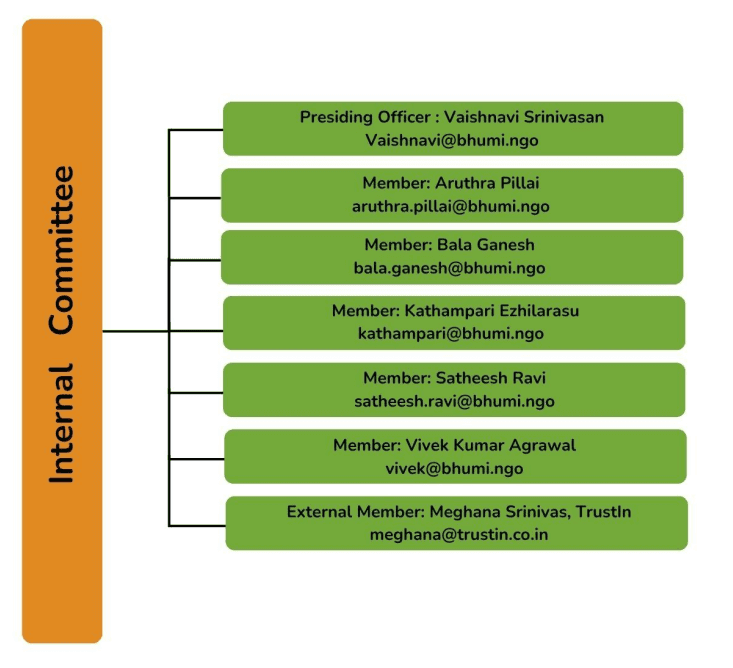
GC – Bhumi has constituted a a Grievance Committee (GC) to address complaints of Sexual Harassment non-women employees (who identify as men or other genders) respectively. The current members of the IC and GC are listed below:

IC – As per the provisions of the POSH Act, Bhumi has constituted an Internal Committee (IC) to address complaints of Sexual Harassment from employees who identify as women. The current members of the IC are listed below:
Bhumi reserves the right to add to, remove or replace the IC/GC members from time to time.
A complaint against any member of the IC/GC should be sent directly to any other member of the IC/GC
The Complainant will have the right to exclude any IC/GC member in exceptional cases wherein there is a chance of prejudice or bias of any
form.
9. Workplace – Bhumi’s offices located in Chennai, and any place (physical or virtual) visited by an Employee during the course or arising out of employment with Bhumi, including social media messages and virtual meetings.
10.Definition of Employee etc. shall be as defined in the Act and also be referred to and/or relied on while investigating complaints made by employees who identify as men or other genders.
III. SCOPE AND APPLICABILITY

The purpose of this Policy is to define the guidelines and the process of redressal to be followed in order to provide protection against Sexual Harassment at the Workplace.
This policy is made effective from 15 April 2022 and revised on April 16, 2026 and is deemed to be incorporated in the job contracts of all Employees.
This policy applies to all employees, fellows, consultants and volunteers (field workers and central office team) of Bhumi, including present and/or future subsidiaries and affiliated companies at their workplaces or at client sites.
Sexual harassment is not only unlawful during working hours or in the workplace itself, but also extends to any place visited by the employee arising out of or during the course of employment, including conferences, work events or field trips (and transportation undertaken for such trips), interactions with third parties such as vendors, working in the office or remotely, at all events hosted by Bhumi, at industry events attended by a Bhumi employee, whether or not directly representing Bhumi and also through all digital spaces (including, but not limited to internal and external
chat groups, email services, LinkedIn, social media platforms and so on).
NOTE: Where the alleged instance of Sexual Harassment is faced by an employee by a third party (Respondent) while on a duty outside the Bhumi premises, Bhumi shall perform all reasonable and necessary steps to support the employee, such as escalation to the Respondent’s applicable Internal Committee, and/or the district’s Local Committee.
IV. ZERO-TOLERANCE APPROACH
Bhumi is an equal employment opportunity employer and has a ‘zero-tolerance’ approach to any form of Sexual Harassment. Bhumi is committed to creating a healthy, harassment-free working environment that enables employees to work without fear of prejudice, gender bias and without regard to race, caste, religion, colour, ancestry, marital status, gender, age, nationality, ethnic origin or disability.
At Bhumi, all employees are expected to uphold the highest standards of ethical conduct at the workplace and while interacting with the stakeholders. This means that employees have a responsibility to:
Follow the spirit of the law
Treat each other with dignity and respect
Refrain from creating a hostile atmosphere at the workplace
Reporting Sexual Harassment experienced and/or witnessed to appropriate authorities and
Abide by the complaint handling procedure of the company
All Employees are responsible to ensure that the Workplace is safe and secure and free of Sexual Harassment. Any Affected Employee with a complaint of Sexual Harassment at the Workplace may complain against anyone, including management, supervisors, co-workers, or visitors, and report the behaviour in accordance with the procedures set out below.

V. PREVENTION OF SEXUAL HARASSMENT
STEP 1: COMPLAINT
The Affected Employee must submit a detailed complaint, in writing, along with any documentary evidence available or names of witnesses, to any of the IC/ GC members either in person or via email to [email protected] or log into the TrustIn Platform (bhumi.trustin.app) to file a complaint within a period of 3 (three) months from the date of incident. In case of a series of incidents, the complaint must be filed within a period of 3 (three) months from the date of the last incident. The time limit can be extended up to 6 (six) months by the IC/ GC if it is satisfied that certain circumstances
prevented the Affected Employee from filing the complaint sooner. If the complaint cannot be made in writing, the Presiding Officer or any member of the IC/GC shall render all reasonable assistance to the Affected Employee for making the complaint in writing. If the Affected Employee is unable to submit the complaint on account of their incapacity, the following may do so on their behalf, with their written consent:
Legal heir, relative, or friend
Co-worker
Any person having the knowledge of the incident
If the initial complaint is made to any person other than an IC/GC member, upon receiving such a complaint, it will be the responsibility of the complaint receiver to report the same to the IC/GC immediately. Since anonymous complaints are difficult to investigate, it is important for the Affected Employee to include their name and as many details as possible in the complaint.
STEP 2: CONCILIATION / INQUIRY
Conciliation: At the request of the Complainant, the IC/GC will take steps to have the matter settled by conciliation before initiating any inquiry under this Policy. However, amonetary settlement cannot be made as the basis of conciliation. If the matter is settled by conciliation, no further inquiry shall be conducted, The IC/GC will record the settlement agreement and provide copies of the same to the Complainant and Respondent.
Conciliation in itself doesn’t necessarily mean acceptance of the complaint by the Respondent. It is a practical mechanism through which the issue may be resolved or misunderstandings cleared. Resolution through conciliation may be completed within 3 weeks of receipt of the Complaint.
Inquiry:
The committee initiates inquiry in the following cases:
No conciliation is requested by the Complainant
Conciliation has not resulted in any settlement
Complainant informs the Committee that any term or condition of the settlement arrived through conciliation, has not been complied with by the Respondent
Inquiry Process:
The IC/GC shall, within 10 (ten) days from receipt of a formal complaint, initiate an inquiry into it. Reasons for not pursuing a complaint, if any, must be recorded in the minutes and made available to the complainant in writing.
The IC/GC shall share a copy of the complaint with the Respondent and give her/him/them 7 (seven) days to submit a written response to the same.
The Complainant and Respondent may submit in writing a list of witness(es) to be called during the inquiry.
If the Complainant or the Respondent desires to tender any documents by way of evidence before the IC/GC, they shall supply original copies of such documents with their signature on the respective documents to certify them to be original copies.
Interim reliefs – During the pendency of the inquiry, on a written request made by the Complainant, the IC/GC may recommend Bhumi to -
I. Transfer the Complainant or the Respondent to any other workplace
II. Grant leave to the Complainant of up to 3 months, in addition to the leave she/he/they would be otherwise entitled to
III. Prevent the Respondent from assessing the Complainant’s work performance
IV. Grant any such other relief as may be appropriate. Once the recommendations of interim relief are implemented, Bhumi will
inform the IC/GC regarding the same.
STEP 3: IC/GC FINDINGS
Where the IC/GC arrives at the conclusion that the allegation against the Respondent has been proved, it will recommend that Bhumi take necessary action against the Respondent, and this may include, but need not be limited to:
I. Counselling
II. Censure or reprimand
III. Formal written apology to be tendered by the Respondent
IV. Written warning
V. Withholding promotion and/or increments
VI. Suspension
VII. Termination or
VIII. Any other action that Bhumi may deem fit
STEP 4: SUBMISSION OF REPORT
The IC/GC shall complete the investigation within 90 (ninety) days from the receipt of the complaint. The final decision shall be communicated to the Complainant and the Respondent.
The IC shall submit an Annual Report to the employer and the District Officer in each calendar year pertaining only to complaints made by women employees. The Annual Report will mention the number of complaints of sexual harassment received from women employees in the year, number of such complaints disposed of, number of cases pending for more than 90 days, and the nature of action taken by Bhumi w.r.t these complaints. It must also mention the number of workshops or awareness programs against sexual harassment carried out.
The IC/GC shall keep complete and accurate documentation of every complaint, its investigation, and the resolution reached. All records will be retained for at least as long as the Complainant and/or the Respondent are employees of Bhumi. Copies of these records will be kept in a confidential and secure location and only be madeavailable to authorised individuals if and as determined by law.
STEP 5: APPEAL
Only in cases of complaints by women employees, either party (Complainant or Respondent) not satisfied with the resolution reached by the IC, or further aggrieved by the implementation or non-implementation of recommendations made, may appeal to the appellate authority in accordance with the Act and Rules.
VI. CONFIDENTIALITY
The identities of the Complainant, Respondent, witnesses, statements, and other evidence obtained in the course of an inquiry, recommendations of the IC/GC, and disciplinary action taken by Bhumi are considered highly confidential materials, and not published or made known to the public or media. Any person violating such confidentiality shall invite disciplinary action.
VII. PROTECTION AGAINST RETALIATION
Regardless of the outcome of a complaint made in good faith, the Affected Employee or Complainant, and any person providing information or any witness, will be protected from any and all forms of retaliation. While dealing with complaints of sexual harassment, the IC/GC shall ensure that the Complainant or her/his/their witness(es) are not victimized or discriminated against by the Respondent. Any unwarranted pressures, retaliatory or any other type of unethical behaviour from the Respondent against the Complainant while the investigation is in progress should be reported by the Complainant to the IC/GC as soon as possible. Disciplinary action will be taken by the IC/GC against any complaints found genuine.
VIII. MALICIOUS COMPLAINTS
Where the IC/GC arrives at the conclusion that the allegation against the Respondent is malicious or the Complainant has made the complaint knowing it to be false or has produced any forged or misleading document, it may recommend that Bhumi take action against the Complainant. The action recommended should be similar to the ones proposed above for a Respondent in case of substantiated complaints. While deciding on malicious intent, the IC/GC should consider that mere inability to substantiate a complaint does not amount to malicious intent. Malicious intent must be
clearly established through a separate inquiry.
IX. ANTI-HARASSMENT POLICY
Bhumi does not tolerate harassment of Employees in any form

Harassment does not need to be recognized as unwanted or unwelcome by anyone other than the Employee being harassed.
Employees are expected to be careful in the words they choose. They must remember that sexist, racist, and other exclusionary jokes can be offensive to those around them. Offensive jokes are not appropriate and will not be tolerated under any circumstance. Consider that calling attention to differences can feel alienating.
Employees asked to stop any harassing behaviour are expected to complyimmediately, in both physical and/or digital spaces of interaction. Action will be taken in accordance with the Bhumi code of conduct against employees violating these norms.
Any negative impact on the Complainant, resulting in an uncomfortable, hostile, or intimidating work environment, shall hold sway over the reported intent of the Respondent.
APPENDIX - A
CONDUCT CONSTITUTING “SEXUAL HARASSMENT”
Sexual Harassment includes unwelcome words, acts or displays. Any conduct that is set forth in the list below or has the same impact as any of these, on an employee, a temporary worker, fellow, volunteer, contractor, or outside visitor, will result in appropriate disciplinary action, up to and including termination of employment or from an assignment with Bhumi.
Verbal harassment includes, but is not limited to:
Any taunting snide remarks based on sex, sexual orientation, gender identity, (possibly including pregnancy, childbirth or related medical condition, marital status or personal appearance)
Using abusive and offensive language or comments that put down people because of their sex or sexual orientation
Phone calls or SMS or messages using social media platforms or on electronic mail or computer networks of a sexual nature which are threatening, abusive or offensive
Sexual messages, text, or images which may be perceived by the recipient as creating a hostile work environment
Suggesting or insisting that someone wear revealing clothing
Intrusive questions about sexual activity; tales of sexual exploits; comments about individual’s bodies or intruding on privacy
Requests for sexual favours and/or sexual advances
Unwelcome proposals such as repeated requests for dates and social contact when individual invited has refused/ignored similar invitations
Sexually suggestive comments, sexually coloured propositions, insults, or threats
Telling lewd jokes about sex or sexual orientation
Offensive language that insults/demeans, including using terms of endearment
Singing or humming vulgar songs, ballads or words
Messages with double meaning
Rumours about an individual’s sexual behaviour
isual harassment includes, but is not limited to:
Graphic descriptions of pornography including graffiti in the office premises
Displaying books, photographs, paintings, films, pamphlets, packages, etc. containing indecent representation of women/men
Displaying, circulating, or placing in another’s workplace or belongings material that is sexual in nature or sexist
Offensive gestures, staring, leering, hooting, or whistling with the intention to insult or discomfort another
Even if not directly done to a particular individual, uttering a word, making a gesture, or exhibiting any object of a sexual nature with the intention that such word, gesture, or object be heard or seen
Sounds, gestures or display of written materials of a sexual nature, including books, pictures, cartoons, magazines, calendars, screen savers
Viewing, showing, or mailing pornographic posters, Internet sites, cartoons, drawings
Suggestive letters, phone calls, electronic instant messaging or e-mail messages of a sexual nature
Physical harassment includes, but is not limited to:
Intentional touching of the body, e.g. unwelcome hugs, kisses, brushing, fondling, pinching, patting, stroking, back rubbing, etc.
“Accidentally” brushing any parts, especially sexual parts of a co-worker’s body
Any display of affection which can make others uncomfortable or are inappropriate at the workplace even if based on consent of the individual who
participates
Indecent exposure
Sexual assault (Coerced sexual intercourse or digital penetration)
Blocking passage or walkways
Use of technology to induce different remote sensations on the body including, but not limited to pain and sexual stimulation
Sexual assault or using criminal force to any woman, intending to outrage or knowing it to be likely that the perpetrator will thereby outrage her modesty